
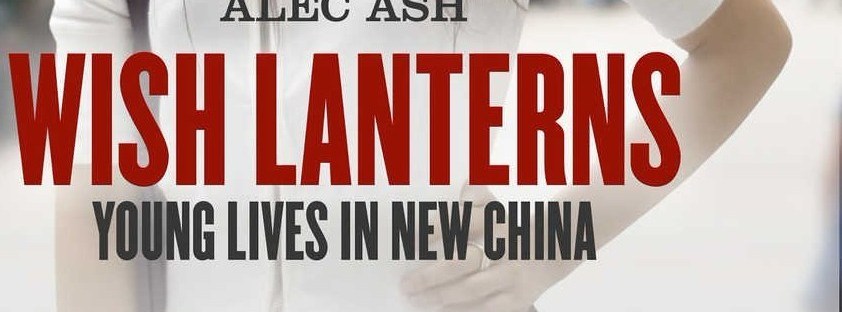
“Wish Lanterns”: Poignant Entertainment for All Levels of China-Watcher

This was originally published on The Nanfang July 29, 2016

Steven Pinker, author of “The Better Angels of Our Nature”, has cited literacy as a major force for world peace. He points out that at times of increasing literacy books like “Oliver Twist”, “Uncle Tom’s Cabin” and “All Quiet on the Western Front” helped bring to light the sufferings of people who might otherwise have been ignored.

“Wish Lanterns” by Alec Ash does not focus on extremes of poverty and upheaval, but instead describes in intimate detail the lives of six people whose experiences will be alien to much of the readership. They are China’s millenials, the generation born after the political catastrophes of the Mao era when Deng Xiaoping’s economic reforms brought unprecedented peace and prosperity to the People’s Republic.

By minutely focusing on these lives, “Wish Lanterns” serves to both demystify a nation which is by turns demonized and exoticized as well as educate even the most experienced China watchers about the people who will write the next chapter in the Middle Kingdom’s history. The three male and three female subjects were born within five years of each other, all have a university education and all have lived in Beijing.

It is not a comprehensive portrait, but the depth and quality of the writing make it well worth anybody’s time. By removing himself from the action – though Ash was present at some of the key scenes described – the book gets fully under the skins of six Chinese people who have come of age at the beginning of what some say will be the Chinese Century.

One of the characters flies to Shanxi Province to meet a person with whom she has exchanged flirtatious WeChat messages. Within eight pages they have shaken hands, flirted, declared their love, been to bed, met the parents, and married, a series of events that covers a timespan of thirty-five days.

This might seem profoundly weird to a cosmopolitan person of the same age. In another writer’s hands, the chapter would probably be a frontrunner for the Bad Sex Award, but Alec Ash has so comprehensively evoked the pressures, dilemmas and uncertainties that the subjects face, that readers will find it difficult to imagine themselves doing things differently. The spare prose and rugged, unforgiving setting even help make it romantic, despite the immediacy with which the couple discusses marriage as a practical arrangement.

“Wish Lanterns” is littered with exquisite touches. When the rebellious, tomboyish Mia is offered a fashion stylist job at Bazaar, it is described as the kind of job her more demure friends “would have given a gloved arm and stockinged leg for.” The weekend bonanza of families visiting Ikea describes scenes in which couples “have real domestics in fake kitchens.”

Perhaps the strongest and most dramatic chapter in the whole book involves Snail, a boy from the Anhui countryside who is the first in his family to go to college, making it all the way to the nation’s capital for his studies. The scene is set in the mid-2000s when World of Warcraft was at the height of its popularity. Standout lines include: “The game offered a sense of accomplishment that three-dimensional life lacked”.

Snail is apprehended by his parents for neglecting his studies due to his gaming addiction. Like the rest of the book, the moment is brilliantly grounded in the five senses (“Snail was pulled out of World of Warcraft to face something he hadn’t seen in a long time: sunlight”.) Every viewpoint is poignantly observed and no person is judged (“With the supervisor’s help, the first time his mother used the Internet was to look up the website for an Internet-addiction rehab center”.)

The book covers issues with which any China-follower of the past decade will be familiar, from the Wang Yue tragedy to the downfall of Bo Xilai. Yet as well as looking at old issues in a new light, it will teach just about any China hand things they did not know.

One subject Fred, a Tsinghua University graduate from a privileged Hainan family, encounters the New Left thinker Pan Wei who is too radical for even the left wing of the Communist Party. The West, Pan Wei argues, is historically a nomadic society which by nature favours individualism, while China is by tradition agrarian and better suited to traditionalism. The evolution of Fred’s political thinking is one of the most engaging elements.

Yet politics is only a tiny part of “Wish Lanterns”. Through his interviewing skills and keen observations, Alec Ash has interwoven six compelling stories and unobtrusively presented the economic, historic and cultural realities that lie within.

“Blind Water Pass” by Anna Metcalfe: Haunting Stories of Intercultural Miscommunication

This was originally published on The Nanfang on October 10, 2016

In theory, the art of the short story is uniquely well-suited to the internet age. Like good web copy, a short story should grab the reader with the first line and keep them hooked. Like good web copy, a short story should be like perfect abs, everything in its right place and with no flab.

In fact, the opposite is the case. You can’t read a short story properly online. They demand something that today’s digital world forbids us from giving: our undivided attention.

“Blind Water Pass”, a collection of short stories by Anna Metcalfe, some of which are set in China, deals with issues that are often too discomforting to think about. These include the plight of immigrants who live in the grey areas of the legal system, the communities and traditions that are being destroyed by ruthless progress, and the suffering of people who make life in developed countries so comfortable.

The collection supports John Carey’s assertion in “What Good Are the Arts” that literature is a profoundly middle-class art form, historically hostile to pride, grandeur and self-esteem. Most of its central characters are caught up in social and geopolitical forces beyond their understanding.

One standout example is “Number Three”, which was shortlisted for the 2014 Sunday Times Short Story Award. It takes place in a city’s Number Three Middle School and focuses on Mr. James, a foreign English teacher, Miss Coral, who is appointed as his liaison, and Moon, a diligent student who takes tuition from Miss Coral.

The story captures the slowness of life in a Chinese public school and the smallness of the individual in its vast mechanism: “(Moon) neither seeks friendship nor refuses it, and wanders the extensive grounds of the school wearing a look of mild surprise, as though perpetually living her first day.” Like most of the stories, it is not particularly action-packed, but teases out the notion that when spending time in an alien culture, we may do much more damage than we intend by seeking to be understood before trying to understand.

Metcalfe seldom specifies where the stories are set, but those that explicitly take place in China capture the uniqueness of the Middle Kingdom and at the same time demystify it. The following description appears in “Number Three”: “A late afternoon sun casts a haze over the urban sprawl. Smog and fresh dust linger, hovering over warehouses, slums and disused factories as they leave the inner city and approach the airport.”

The collection’s title piece revolves around a girl who entertains tourists with made-up Confucian quotes. This serves as a metaphor of how China’s ancient history is ever-changing to fit the needs of the present.

The central conflict is between the teenaged Lily and her grandmother, who clings onto a folk spirituality that she cannot adapt to the new China. Lily speaks implausibly good English for a rural girl, able to discern the quality of translations and to edit them, but like all good fiction, these stories operate with their own internal logic.

The three major forces in the story are spirituality, technology and nature, but none appears to have the answers the characters seek: “Lily looks at the sky as though waiting for its wisdom to descend.” By avoiding didacticism or a clear environmental message, it lives longer in the memory than the vast majority of what appears on the internet.

Of the other stories set in China, “Everything Is Aftermath” also follows a young girl stuck between two seemingly irreconcilable worlds. Metcalfe’s minute attention to the details that her viewpoint characters observe recalls some of Katherine Mansfield’s best work: “His ears are stoppered with blue rubber headphones that produce a tinny, rattling sound. It reminds her of the metal gates at her school, the way they clatter in the breeze.”

Other standout pieces include “Old Ghost”, in which the narrator is an immigrant female taxi driver in Paris whose relationship with the mysterious title character was torn apart by unspecified political issues. The hypnotic “Mirrorball” follows a narrator who begins each section by saying her age, following her from nine all the way up to twenty-two as she gradually evolves to become like her abusive father’s attractive young girlfriend.

A graduate of the famous Creative Writing Master of Arts at University of East Anglia, Anna Metcalfe is a ferociously talented writer whose best work is well worth tearing oneself away from the smartphone for.  It has something to say about cultural contrasts that is beyond the ordinarily expressible.